Plov: The Centerpiece of Central Asian Cuisine
Plov is central to Central Asian cuisine.
Photo by I. Ibrahimjon
Let’s be honest, food probably isn’t the reason you visit Central Asia. Participants on the Central Asia Rally are more likely to be excited about visiting Silk Road cities or driving the Pamir Highway. However, if there’s one meal that you can be sure to enjoy on your trip, it’s plov. Popular all over Central Asia (and beyond) this rice based dish has been feeding locals for centuries, and is at the heart of any Central Asian feast.
(more…)
Guest Post: Tony’s Central Asia Rally Story
A guest post by Tony Thorndike, Central Asia Rally veteran.
Tony Thorndike is a Travel Scientists regular, who completed the Central Asia Rally in 2014. He drove all the way from Britain to Bishkek and, even more impressively, back again! He recently wrote about his experiences on the Caucasian Challenge. He can’t resist the charms of Central Asia, so he’s back to do it all again this year. Here’s his story (back when the race started in Budapest, not Astrakhan):
(more…)
Ancient Settlements Discovered near Khiva, Uzbekistan
Just by to the ancient city of Khiva in Uzbekistan, the desert oasis of Khwarezm offers a treasure trove of anthropological and archaeological history. Dotting the vast desert of what used to be ancient Khwarezm are the ruins of countless towns and forts collectively known as the Golden Ring; they’re definitely worth a visit on the fourth day of your Central Asia Rally.
Photo by Dan Lundberg
How come they weren’t discovered any sooner?
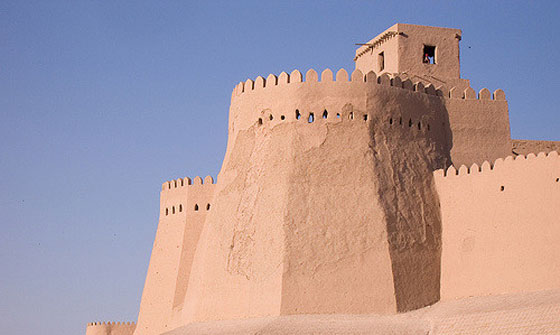
Although the area is known amongst locals as Elliq-Qala, which translates literally as “Fifty Forts.”, just twenty distinct ruin sites have been found up to now. However, this nickname may prove prescient, because new ruins are being discovered (and rediscovered) all the time.
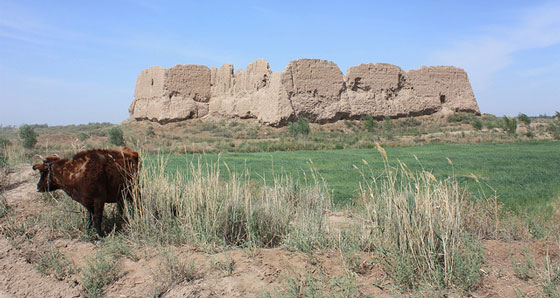
Also, even though the ruins do not technically yet live up to the promise of their name, they still collectively make the area of Khwarezm one of the most fascinating areas to study ancient settlements on the planet.
A small heaven for anyone who likes castles in the sand.
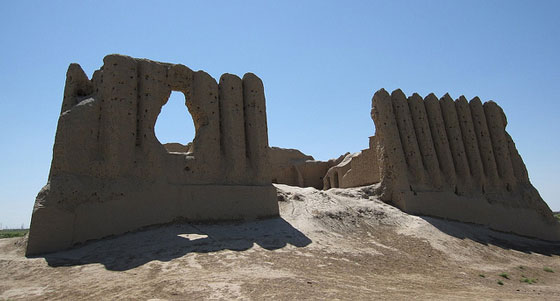
Indeed. Though the Golden Ring of ruins is now completely deserted, with modern Khwarezm settlements being a fair distance away, we can only imagine how bustling and industrious the now-empty desert might have once been with war and trade, settlers and travelers, while examining their society’s dusty remnants.
Outdoor enthusiasts and nature lovers will also find plenty to do here, from scrambling amongst the ruins of the ancient settlements, to camel trekking near Ayaz-Qala. There’s also the possibility of hiking in the Badai-Tugai Biosphere Reserve, which is a tugai (shrubs, trees, and salt-resistant plants unique to Central Asia) forest which is home to over 90 bird- and 20 mammal species.
When were the ancient settlements built?
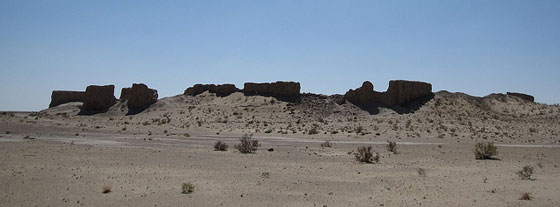
Over two millennia ago, people were already flocking to Khwarezm for much the same reason that they are today – it’s a natural oasis in a region of a harsh, unforgiving desert, feeding from the Aral Sea and providing a maginally more temperate climate and robust vegetation patterns. Because of this, numerous competing tribes built cities and surrounded them with forts for protection in the area.
What’s left of them?
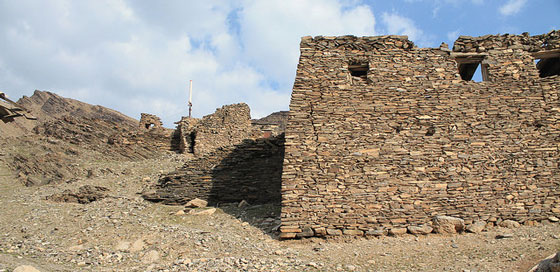
When you visit Khwarezm today, all you’ll see remaining of many sites are the foundations of city buildings and walls, only hinting at the larger structures they once underpinned and protected.
Basements, ramparts, and collapsed underground tunnels leading from city to fort, or city to city, are still being unearthed, which means that Elliq-Qala is one of the more exciting archeological sites of the present era. Contemplating it certainly does ignite your imagination, and make you feel a part of something truly ancient and awesome. Join us on our next Central Asia Rally to see/feel for yourself.
What’s the best way of getting there?
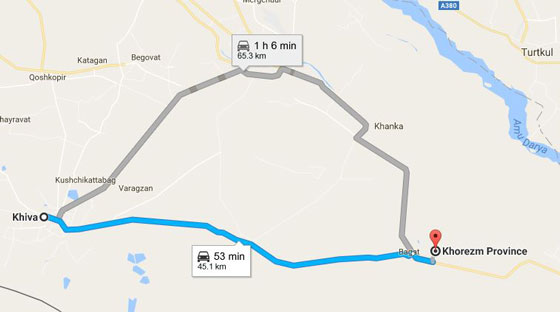
It’s just off the main road about 60km north of Urgench. Bear in mind though that, the central part of the reserve, which contains most of the flora and fauna of interest including the Bukhara Deer, may be closed to visitors from time to time, so it’s worth checking before you set off.
Melmastia and the Principle of Central Asian Hospitality
As a teenager I saw a movie that made a great impression on me. The Beast (or The Beast of War) was an OK B-movie, but not grandiose or original enough to make cinematic history. Still, what it taught me about Central Asian hospitality and honor makes me remember it to this day.
Image: RSM
It was about a Soviet tank crew in the Afghan war around 1980. The storyline had been done many times before, justice coming before duty, joining the enemy who we believe is right. Mind you, the film was made in 1988, during the Cold War, so Soviets are evil, except for one, who hates his comrades. In the end good wins and villains get their punishment. (The Central Asia Rally offers completely different kind of adventure, don’t worry).
What made the film interesting for me were the details about Afghan culture. I had had some vague idea, but never heard of these rules of clan ties, honor, revenge (badal) and Central Asian hospitality. I was fascinated, but didn’t quite follow up on it – this kind of Hollywood movies are notorious for making up anything the producers can’t be bothered to research. But as I later learned, it’s not only culturally accurate, but a very much alive code. Central Asian hospitality is still governed by melmastia, the principle of hospitality, and its equivalents in other peoples around.
Hospitality is Stronger Than Revenge
The Soviet protagonist – in a dramaturgically far-fetched way – finds out about the principles of Pashtun honor code, the Pasthunwali, including hospitality (melmastia) and sanctuary, nanawatai. The latter basically means that no matter what offence one gives to another, what they had done, if they claim sanctuary (nanawatai), one is obliged by the Pasthunwali to take them in. Anyone under nanawatai must be treated as an honored guest, given full melmastia.
Koverchenko (the good Soviet), who conveniently learned of the Pasthunwali a few days ago, claims nanawatai. He is taken in by the son and brother of those his tank crew killed (not without hard feelings, of course), even though the Afghans were out for badal, revenge. The best scene, standing out from an otherwise indifferent film must be the melmastia in the cave. The angry, spiteful Pashtus grudgingly collect all their food to feed the Russian. It’s obvious how much they don’t want to, but showing how strongly the code of Pasthunwali binds them.
Central Asian Hospitality Overwhelms You
Melmastia, when given good-heartedly, is an overwhelming concept we westerners can’t even comprehend fully. As it is said, a good Western host shares everything with his guest – Melmastia means giving it all. This Central Asian hospitality must be offered to anyone who needs it, be that anyone of another tribe, religion or race. And the amazing thing is – they do. When you visit Afghanistan, or any other country along the route of the Central Asia Rally, complete strangers will offer you their home and table. The most important thing is, it must be given selflessly, and without expecting anything in return.
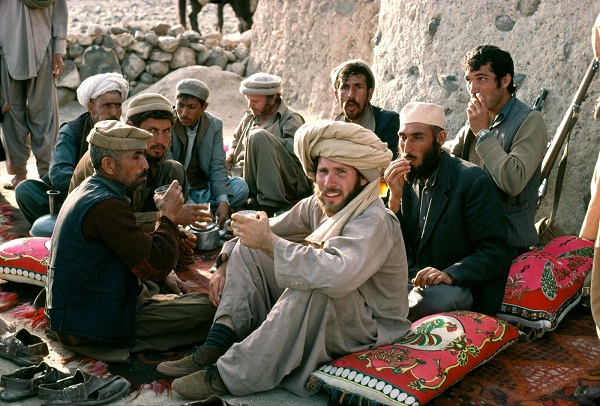
Still, what you can and must give in return, is respect. Respecting traditions, humble surroundings, unfamiliar customs – Central Asian hospitality will sometimes surprise you! That includes taking your shoes off, tasting unappealing foods, and never indicating you find them inhospitable. Even the slightest, most innocent hint will be taken in dead seriousness. If you tell your host you don’t like fish, he’ll probably kill his only goat for you, even if that means starving for the winter. And never offend your host’s household!
Melmastia is Alive
This might be the most difficult thing to comprehend about Central Asian hospitality: how seriously it is taken. It is such a strong code, that for most Central Asian people it is the only honorable way to act. Someone who fails to comply will lose face in the community forever. We can say that we in the west have our own honor code and morals, but honestly, how many of us would go out of their way to live by them?
Hunting with Eagles in Kazakhstan – Qusbegi
Falconry is a respectable and spectacular tradition, and hunting with eagles is the top of that sport. Though hundreds of years past its peak in the Western world, if a handler appears in a Renaissance fair with his majestic bird of prey, he will definitely steal the show from even the best of fire-jugglers. People are fascinated by these free and powerful birds, and how these rulers of the air can be controlled by the strong will of an expert handler. Not a freak show, like the circus, but subduing the best of the air, to serve man with what it’s best at. Until someone develops fishing with a trained shark, this kind of hunting will be the non plus ultra of animal handling.
Photo by www.david baxendale.com
Hunting with Eagles – the Golf Club Membership of Our Ancestors
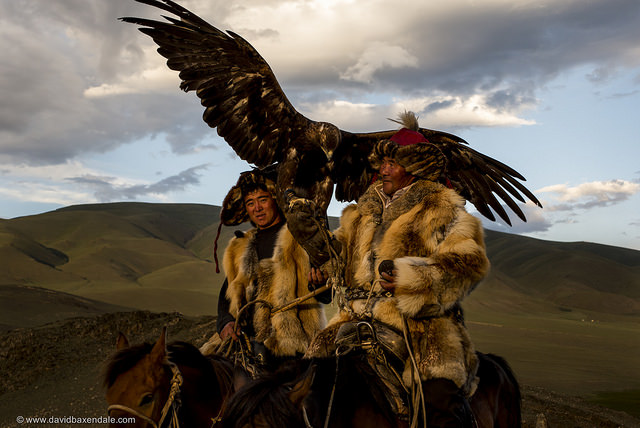
Hunting with trained predatory birds is believed to be dating back to ancient Mesopotamia, almost 4,000 years ago. It gained popularity in China and the wide-open Asian steppes, and said to have arrived in Europe brought by Attila and the Huns. The Christian nobility took up the sport after the Crusades, where they learned it from the Arabs. The popularity of the sport peaked around the 16th-17th century, since then it is only the passion of a selected few enthusiasts. Passion, because it is much more than a pastime – training and hunting with an eagle is an occupation for every day, and cannot be done – or enjoyed – without full commitment.
It was never an efficient way of hunting, and it was never intended to be. Expensive and incidental, it was the passion of the ruling class. Who else could command the most free of the animals, than one who is used to commanding people? And who else could afford feeding a pound of meat to a bird every day, all year? Falconry was for Mongol khans, European aristocrats, Arab princes and Chinese mandarins, not the common people. But relatively speaking it didn’t cost more than an exclusive golf club membership now. And what is more fun, riding in the wide open plains, with the peak of evolution on your arm, or riding around in a whirring little white cart?
Where Hunting with Eagles is the Identity
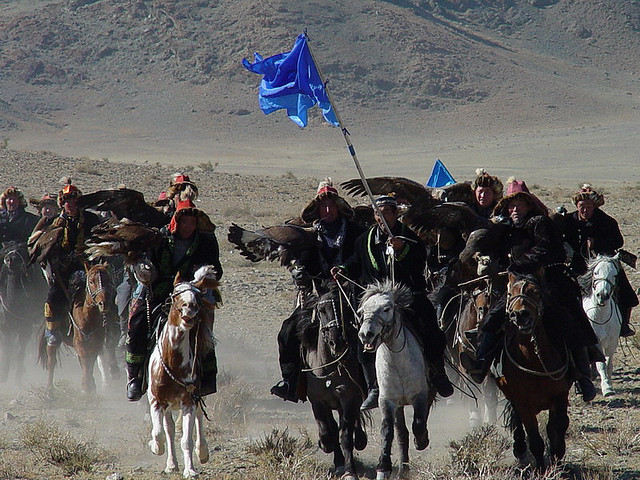
There is an exception to both the decline and the exclusiveness. The Central Asia rally takes you to Kazakhstan, where falconry is an essential part of national identity. It is not only widely practiced, but like many traditions oppressed under Communist rule, is on the rise again. It is the area where the borders of Kazakhstan, Russia, Mongolia and China meet, and nomadic Kazakhs ran to from Soviet rule. They took their traditions with them, and now this exile assures the survival of the ancient sport.
People practice falconry with all kinds of birds of prey here, too, but most respected are the qusbegi. The word means „Lord of birds”, and refers to the golden eagle, the largest and strongest species of raptors man could tame. These majestic birds can weigh up to 15 pounds (7 kgs) and have a wingspan of three feet (1m). The species has a special significance in Kazakh culture, appearing the earliest written records, as well as folk arts and ancient tales.
Is Hunting with Eagles Harmful To Nature Then?
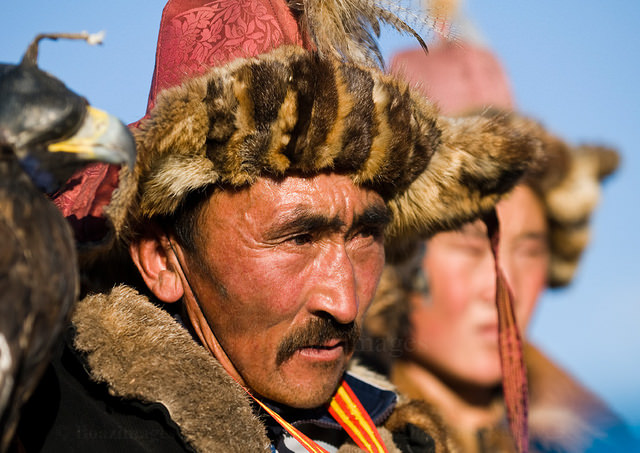
Modern states have a complicated relationship with eagle hunting: On the one hand they promote the tradition, organize eagle festivals, where riders compete and show off their birds’ skills to spectators. This is an increasing touristic attraction for this otherwise undeveloped and remote area. Mind you, even to these mountain people hunting with eagles is more like a passionate hobby, than an actual way of hunting. Men will go to great expense to keep an eagle and go hunt, even if they don’t catch anything.
On the other hand modern states ban the practice of hunting itself, citing conservation as the reason. The population of the main game of qusbegi, the corsac fox dropped significantly, though the species is still not endangered. They are hunted for their excellent winter fur. The reason they quote for the ban is to protect the golden eagle, but then again – they don’t enforce the ban. In theory, a policeman should arrest every competitor at a golden eagle festival, which of course they don’t, although China has been making the life of qusbegi in the past few years difficult.
Why the Tradition May be Good for the Eagles
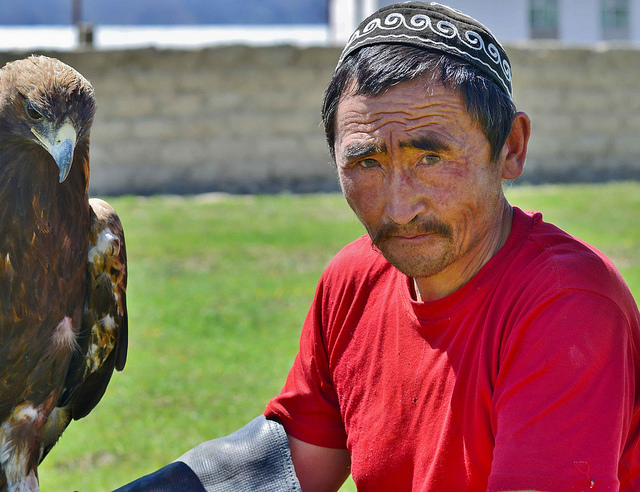
Those hunting with eagles follow a strict code, and claim they are vital to the preservation of this highly endangered species. They capture young eagles (preferably females, which are bigger and stronger) ideally around the age of six. With an expert handler, after a few months of training they are ready to hunt. However, after ten years the eagles are released back into the wild to breed. Golden eagles can easily live past 30.
The released birds are strong, healthy specimens, which nevertheless didn’t lose the skill to hunt. Qusbegi say the species is a lot safer this way: There are slightly more birds than the ever-shrinking natural habitat could support, with a good deal of the population in safe care at any given time. Eagles who spent time with humans are more likely to breed in less isolated spots, too. So who is right?
It is easy to what fascinates Kazakhs about these birds. They are powerful and beautiful. To make them act so much against their nature is to prove man’s superiority every day. This might be an outdated view – captivating, nevertheless. For those concerned about these extraordinary birds, it can be reassuring, that as long as the traditions lives, the existance of the species is assured. Everybody can agree, that this noble and ancient tradition is worth preserving. Unless one’s a corsac fox.
The Ghost Ships of the Aral Sea
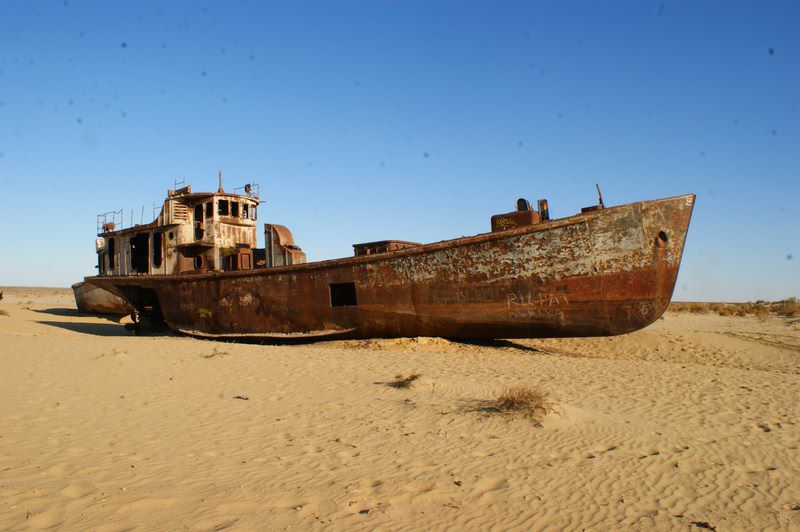
Driving through Kazakhstan during the Central Asia Rally you will stumble over something weird: ships. Old, abandoned ships in the middle of the desert with no water in sight up to the horizon. No, they are not remnants of the Great Flood, but you are standing on the bed of the former Aral Sea, once the fourth largest lake in the world.
Not long ago, there was a completely different picture. Endless waters swarming with fish, boats cruising over the lake, fishing, providing more than 60 000 with a job and a steady income.
Then in the 1960s, the Soviets decided to increase the cotton production in Uzbekistan, Turkmenistan and Kazakhstan. Many of the new cotton fields were on dry desert soil and thus huge amounts of water were needed to sustain them. It was taken from the Syr-Darya and the Amu-Darya river, which were feeding the lake.
This was when one of the greatest environmental disasters of our time took its course. Losing its water source, the Aral Sea fell almost completely dry within a few decades, being reduced to mere 10% of its original size in 2007. The remains of the once huge body of water have split into four small lakes, of which one dried up in 2014, leaving behind a new desert.
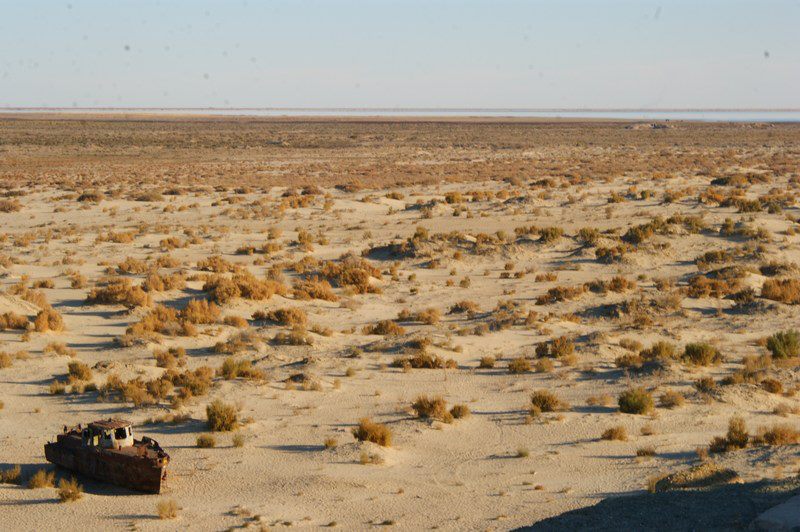
With the lake also the 20 indigenous species of fish disappeared, just like many other plants and animals, and even the climate changed to longer and colder winters, followed by hotter summers.
In 2005 a dam was constructed, which has successfully risen the water level of the northern lake by 12m.
But what is an incredible ecological and economical disaster for the region, provides it with a unique attraction after all: the ghost ships of the Aral Sea – the old fishing boats left back in what is now the middle of the desert, some of them as far as 90km from the waterside. They are amazing places to explore and for making every little boy’s dream of being the captain of a huge boat come true, even if it is just in a sea of sand.